The digital SAT shift has laid bare tensions around educational equity and admissions competitiveness. The Harvard math course controversy likewise shows how distortion and political framing can obscure the real issues – Editor’s Note
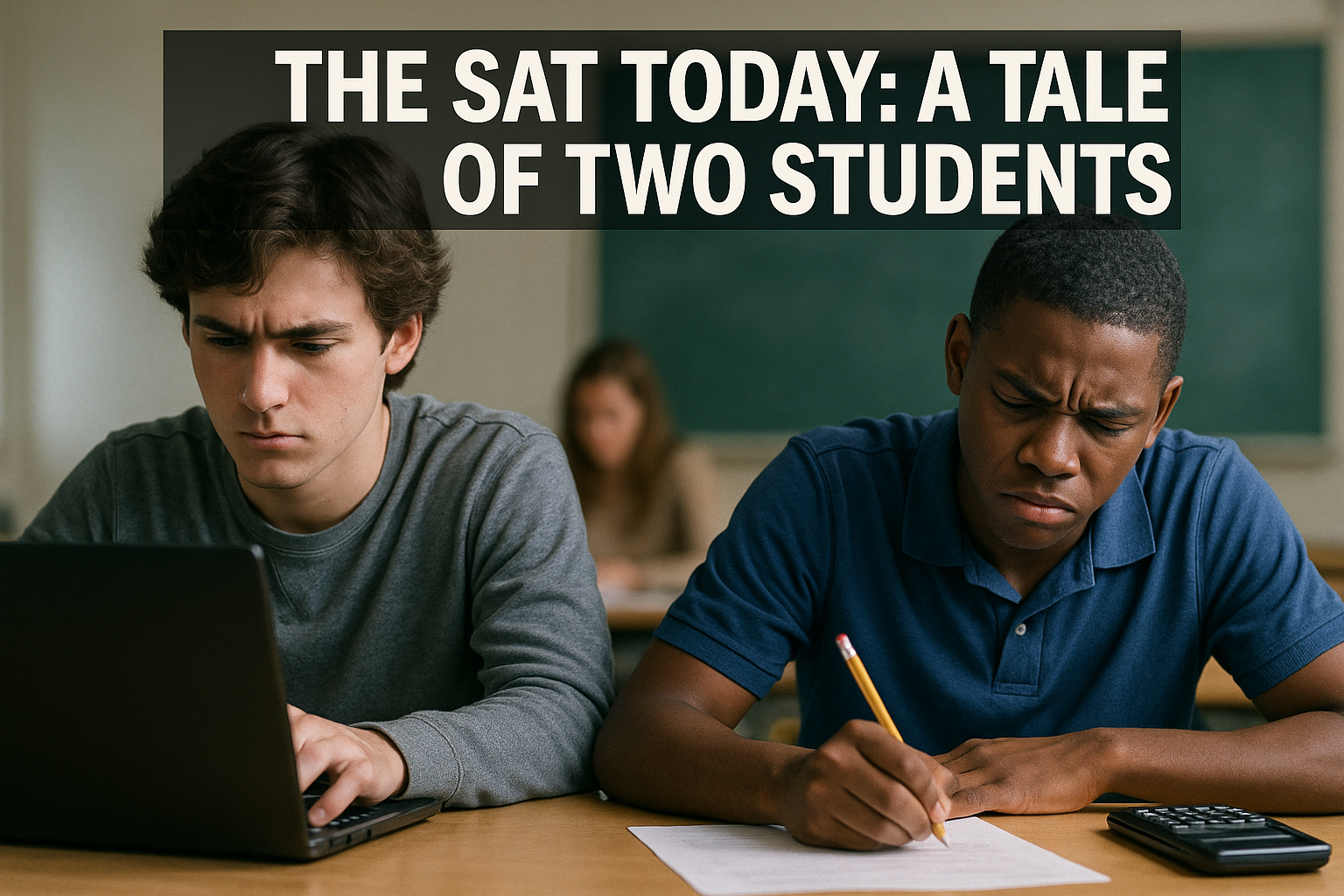
The SAT Today: A Tale of Two Students
In recent years, the SAT—a cornerstone of U.S. college admissions—has become emblematic of a broader educational struggle. While some students master the digital format and excel, others face mounting hurdles: technical glitches, shifting formats, and widening achievement gaps.

The Digital SAT’s Growing Pains
As the SAT shifted entirely to a digital format in March 2024, students have grappled with unfamiliar testing dynamics. The new adaptive format, shorter reading passages, and full calculator access fundamentally changed the testing experience (crimsoneducation.org).
One challenge lies in the adaptive scoring: students routed to the easier second modules in Reading/Writing or Math face capped scores even if they answer all questions correctly—creating a structural disadvantage (highambition.org). Technical issues further intensify the pressure: a 2023 report noted 4% of test-takers experienced interruptions due to device or connectivity failures; an analysis found those affected scored about 30 points lower, even though official scores aren’t adjusted.
The fallout is real. In March 2025, CBS News announced a technical glitch caused early auto-submission for over 10,000 SAT-takers worldwide. More recently, on August 23, 2025, at San Francisco’s Moscone Center, roughly 600 of 4,000 students couldn’t complete the digital SAT due to Wi-Fi failures—causing chaos, delays, and emotional distress. While the College Board refunded and offered rescheduling, the incident underscored the fragility of the digital testing infrastructure. A similar outage had disrupted 1,400 students in Oakland the previous year (sfgate.com).
 Shrinking Scores and Growing Disparities
Test-scores tell a sobering story. The class of 2024 saw average SAT scores drop slightly—from 1028 to 1024—despite nearly two million students taking the test. In urban contexts, the decline can be dramatic. New York City public school students in 2024 averaged only 473 in math and 482 in reading/writing—far below both state and national averages, as New York City Post stated.
Socioeconomic and racial inequities persist. Less than 25% of Black students and under 33% of Hispanic/Latino students meet SAT “college-ready” benchmarks, compared to 59% of white students and 80% of Asian students. These disparities point to uneven access to resources like test prep and robust schooling.
Stratified Outcomes: Who Aces It, Who Struggles?
Why the divergence? Students who receive structured support—whether through schools, financially backed prep programs, or homeschooling—tend to thrive. That youthful summer/fall senior-year performance peaks because older, more mature students invest more heavily in preparation.
Conversely, the digital format’s volatility encourages retesting, which advantages affluent families who can afford multiple attempts. Additionally, school grading inflation and variable curriculum standards create disconnects between GPA and test readiness.
The Fairness Question: When One Test Feels Like Everything
While the SAT is often promoted as a tool to level the playing field, many students experience it as a roadblock—one that can feel deeply unfair. For high-achieving students who struggle with standardized testing, the stakes are crushing: a single number can mean the difference between an acceptance letter and a rejection from Ivy Leagues, Stanford, USC, or UCLA.
This is especially devastating given the popular saying, “One test doesn’t define who you are.” In reality, for many top-tier admissions committees, an SAT score still plays an outsized role—especially when it’s used as a tiebreaker among competitive applicants (usatoday.com).
For students from under-resourced schools, English language learners, or those with test anxiety, the SAT can become more about navigating systemic barriers than measuring true academic potential. Even with the rise of test-optional policies, research shows that applicants with strong SAT scores are still admitted at higher rates—suggesting that optional doesn’t always mean irrelevant (washingtonpost.com).
When students pour years of effort into their grades, extracurriculars, and community contributions, only to be reduced to a single test score in the eyes of admissions, the result can feel not just competitive—but demoralizing.

“Harvard Students Are ‘Stupid’ Now”? The Remedial Math Controversy
The claim that “Harvard students are stupid now”—couched in the rumor that they need to learn “two plus two”—circulated widely in 2025. It stems from a misreading of Harvard’s new Math MA5, a revamped introductory calculus course with extra support for algebra and geometry—not basic arithmetic (wsj.com).
According to The Crimson, Harvard’s MA5 meets five days a week, includes foundation-building workshops in algebra, geometry, and quantitative reasoning, and share identical content, pacing, exams, and grading with its standard calculus counterpart. This design is a response to pandemic-induced learning loss, not a decline in academic standards—especially given Harvard students’ historically high incoming SAT math percentiles (median around 750–790).
The Trump administration escalated the narrative, framing the class as evidence of Harvard’s academic decay and even threatening federal funding consequences. Yet fact-checkers and education analysts debunked the claim: Harvard continues to uphold rigorous calculus instruction, and the course isn’t remedial in the common sense—it builds on gaps to access college-level work.
Conclusion: A Payment on Equity, Readiness, and Perception
The digital SAT’s uneven rollout and adaptive quirks illuminate deeper equity issues: while some students thrive, many struggles stem from technical failures, format shifts, and resource disparities. Test-optional policies have alleviated some pressure—but for students at places like Harvard, standardized scores still play a definitive role in admissions.
Against this backdrop, Harvard’s remedial-framed calculus course reveals not academic decline, but an evolution: reinforcing foundational learning post-pandemic, even among students with near-top test scores.
In short, the SAT remains a double-edged sword: a valued benchmark for some, a barrier for others. And headlines painting elite students as “stupid”? Often a distortion rather than reality.
<Student Report Allyson Park> LACHSA addising16@gmail.com